

The Fine Print Behind the GOP’s Plan to End Aid to Israel
One of Congress's most pro-Israel Republicans wants to end direct military aid to Israel. The real question is whether the money disappears—or simply moves somewhere the public can't easily follow.


Welcome back to The Red Letter.
The politics around Israel are shifting so quickly that it’s becoming difficult to tell where symbolism ends and substance begins.
That’s why I wanted to interview Rep. Marlin Stutzman, one of Congress’s most pro-Israel Republicans, after he introduced a memorandum of understanding that would phase out the $3.8 billion the United States sends Israel each year in military aid.
On its face, that’s a remarkable shift.
But is it actually ending military aid? Or is it simply changing the way the relationship is financed?
The memorandum leaves open significant questions about joint defense cooperation, co-production of weapons, and whether American taxpayers could still be footing much of the bill—just through channels that are less visible to Congress and the public.
At a moment when support for foreign aid is eroding across the political spectrum—and particularly among the younger, America First wing of the Republican Party that helped propel President Trump back to the White House—the idea of ending military aid to Israel has gone from politically untouchable to politically viable.
Many Democrats have also become more critical of unconditional aid to Israel, particularly as the war in Gaza has dragged on. Add to that a $39 trillion national debt and it’s not difficult to understand why this conversation is happening now.
But there’s another force pulling in the opposite direction.
Antisemitism is rising in the United States and around the world. Hamas’ October 7 attack fundamentally reshaped how many Americans view Israel’s security needs, while also exposing deep political divisions over the country’s aggressive military response. For many Republicans, continued support for Israel remains both a strategic and moral imperative.
That is what makes Stutzman’s proposal so fascinating. This isn’t coming from one of Israel’s critics.
It’s coming from one of its allies.
Even more surprising, Israeli Prime Minister Benjamin Netanyahu says he wants the same thing. He actually sent a letter to Stutzman on June 1, 2026, two days before the resolution was introduced, calling it “my plan.”
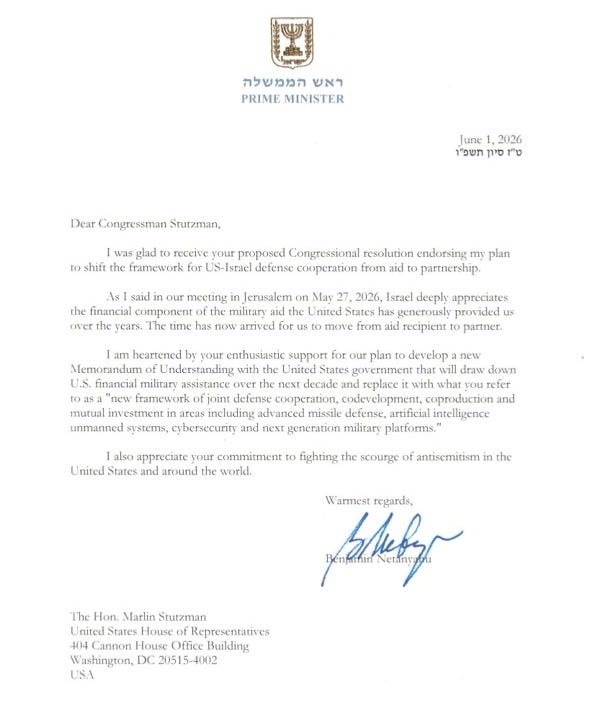
“I want to draw down to zero the American financial support, the financial component of the military cooperation that we have,” Netanyahu told CBS’s Major Garrett. “I think that it’s time that we weaned ourselves from the remaining military support.”
Netanyahu’s argument is straightforward: Israel’s economy is approaching $1 trillion in GDP, it has become one of the world’s leading innovation hubs, and mature allies shouldn’t depend indefinitely on American taxpayers.
Stutzman echoed that argument when I sat down with him this week. It’s an argument that will resonate with many fiscal conservatives.
But reading Netanyahu’s letter and Marlin’s resolution, I found myself different questions.
Should foreign leaders be dictating legislation to American politicians?
Is America actually ending military support for Israel? Or is it simply changing where that support lives?
The language in the proposal calls for expanded joint defense cooperation, co-development, and mutual investment. “joint defense cooperation,” “co-development,” and “mutual investment” in defense technologies.
Those phrases sound innocuous. They’re also incredibly broad.
When I pressed Stutzman on what “co-production of weapons” actually means, he pointed to existing collaborations like Iron Dome and argued that countries routinely develop defense technology together. He rejected suggestions that the proposal was designed to hide military assistance inside the Pentagon.
But the question remains.
If direct State Department military aid disappears only to be replaced with Pentagon-funded joint weapons development, how much has actually changed?
How much of that research and development would still be financed by American taxpayers?
How much congressional oversight would exist if funding moved into classified defense programs rather than traditional foreign assistance?
The devil, as always, is in the details.
This debate also intersects with another proposal making its way through Congress: the United States-Israel FUTURES Act, legislation designed to deepen U.S.-Israeli defense technology cooperation. It was not introduced as a bill on its own, but an element of the act, the United States-Israel Defense Technology Cooperation Initiative, was folded into the National Defense Authorization Act. The House Armed Services committee “Defending Israel” fact sheet called "it "unprecedented levels of support for the security of Israel."

That raises uncomfortable questions about where the relationship goes next.
One example is Pegasus, the sophisticated spyware developed by the Israeli company NSO Group. Pegasus can infiltrate smartphones without the user clicking a link or downloading malware. It has reportedly been used against journalists, dissidents and political opponents around the world. The FBI tested Pegasus but ultimately decided not to deploy it operationally amid concerns over security and civil liberties.
Rep. Ro Khanna (D-CA) has been among the lawmakers warning that Congress should exercise far greater oversight over emerging surveillance technologies and U.S.-Israeli technology cooperation, arguing that democratic allies should not be exempt from scrutiny simply because they are allies. He called it a “fusion” of the two militaries that prevents oversight.
To be clear, Stutzman told me Pegasus has nothing to do with his memorandum and dismissed suggestions that the proposal is intended to integrate the two militaries or conceal aid.
“I think that, you know, too many times people are looking for a conspiracy somehow that we’re going to integrate the military, that’s ridiculous,” he said.
He described the framework as a high-level vision that would require substantial negotiation before any details were finalized.
“It’s a broad language and so there will be more details to be worked out. Okay,” he said. “But there are countries that we do work with that you know we do co-investment on projects.”
Perhaps that’s true.
But broad frameworks have a way of becoming very specific once appropriators, defense contractors, intelligence agencies and foreign governments begin filling in the blanks.
That’s why I wanted to have this conversation now.
Ending aid to Israel sounds simple.
If military assistance is simply folded into Pentagon spending through joint defense programs or weapons co-development, what happens to congressional oversight? How do lawmakers—and taxpayers—know how much is being spent, where it's going, and what leverage Congress retains if that funding is no longer appropriated as traditional foreign aid?
Watch my full conversation with Congressman Stutzman above, and let me know what you think.
Is this genuine fiscal restraint?
Or is it simply military assistance by another name?
For many, many reasons I am decidedly on one side of this issue but I also thought that this interview its companion piece were extraordinarily fair, which I value more from someone with Ms. Palmeri’s job description than merely having my own views validated. I would take issue with just one thing, and that is the use of the term ‘antisemitism’ over ‘anti-Zionism’. Not interchangeable, unless one actually believes that the majority of this country, the majority of the populations of the majority of nations on earth, a pretty fair number of Jews are antisemitic.
How did we cut so much spending with DOGE but no changes in support to Israel. Other countries should never be on a retainer off of American tax payers