

The Epstein Files and the Prosecutor Under Scrutiny
Jay Clayton now oversees Epstein-related disclosures and investigations touching figures from his professional past.

Welcome back to The Red Letter.
The Epstein scandal has never been just about a dead financier or sealed documents. It has always been about who controls exposure and who decides what accountability looks like.
That power now sits with Jay Clayton, the U.S. Attorney for the Southern District of New York. His office oversees key aspects of compliance with the Epstein Files Transparency Act, controls the core archive of Epstein-related material, and is actively responsible for investigations into Democratic figures connected to Epstein giving Clayton extraordinary discretion over what is released, what is pursued, and what remains untouched.
That matters because Epstein survived for decades not through secrecy alone, but through proximity to power across parties, administrations, and institutions that rarely agree on anything except self-preservation. And Clayton’s professional history places him inside that same ecosystem.
To understand why, it helps to look at how Epstein embedded himself at the highest levels of influence.
When Maria Farmer reported Epstein in 1996, Epstein was a donor and confidant of President Bill Clinton. During the George W. Bush years, he was represented by Ken Starr. He maintained ties to Bill Barr, whose father had once hired Epstein to teach at Dalton despite lacking a college degree.
After Epstein’s 2008 sweetheart non-prosecution agreement, he quietly consulted Kathy Ruemmler, President Obama’s former White House counsel, on how to undermine Giuffre—specifically, how to kill her planned ABC News interview. Emails later revealed Ruemmler expressing enthusiasm over gifts from Epstein, including a Birkin bag and a luxury spa trip.
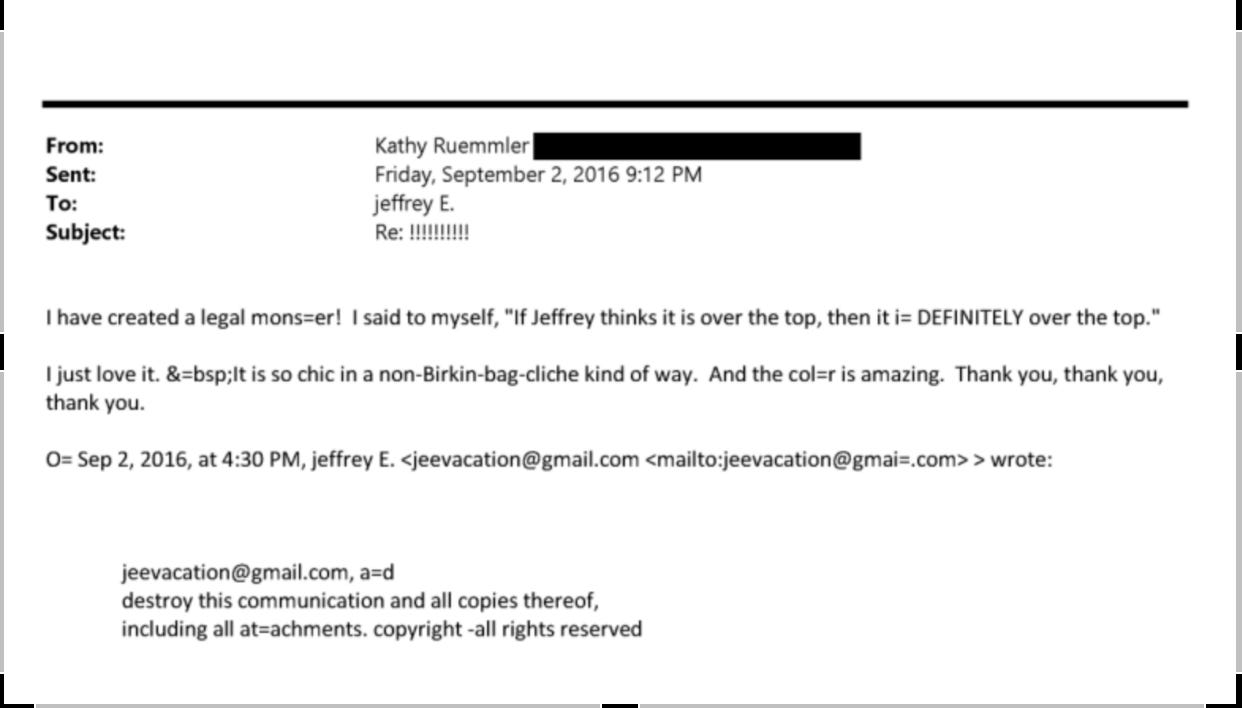
This was not a casual relationship. Reporting by CNN’s Andrew Kaczynski documented more than 100 email exchanges and over 50 meetings. Epstein referred to Ruemmler as his “great defender.” She called him “wonderful Jeffrey.”
Ruemmler later fought to keep her communications with Epstein sealed under attorney-client privilege even after his death. Today, she remains chief legal officer at Goldman Sachs, where former Bush spokesperson Tony Fratto, now the firm’s publicly defended her against scrutiny.
Epstein cultivated relationships with prominent Democrats including New Mexico Governor Bill Richardson and Senator George Mitchell—both accused by Virginia Giuffre of abuse—and remained close to figures like Biden’s envoy John Kerry and former CIA director Bill Burns.
And then there is Trump’s universe, where Epstein’s web stretched to the top: the president himself, Elon Musk, Commerce Secretary Howard Lutnick, and Trump’s Fed chair pick Kevin Warsh.
Trump once warned Rep. Marjorie Taylor Greene to stop pushing for full release of the Epstein files: “My friends will get hurt.”
That warning captures the story in a sentence. The pattern is familiar: elite protection, reputational laundering, institutional silence.
That brings us back to Clayton, whose recent professional ties intersect with two of Epstein’s closest confidants, both now under renewed scrutiny.
🔒 Paywall: Keep reading to understand why Jay Clayton’s past matters now…
