

Postscript: Why I Published My Full Interview With Congresswoman Kat Cammack
Pro-life Congresswoman Kat Cammack says she asked me only to delay publication of our interview about her pregnancy emergency that required an abortion. My contemporaneous notes do not reflect that.

Welcome back to The Red Letter.
And welcome to Postscript, where I reveal the story behind our stories—the reporting, the conversations, and the careful editorial deliberations required to publish news and insight when the stakes are so high and the pressure not to publish can be even higher.
After my interview with pro-life Congresswoman Kat Cammack (R-FL) about her life-threatening pregnancy emergency—which required an abortion procedure—was viewed more than six million times, she publicly alleged that she had asked me only to delay publication of that portion of the interview until the man she says has threatened her was “located,” after which I would have been free to publish it.
That is not what happened.
Because the circumstances surrounding publication have themselves become part of this story, I believe it’s important to document what occurred accurately, according to my contemporaneous notes.
The interview
On June 19 at 11:00 a.m., following a June 3 request from her office, I interviewed Cammack for The Tara Palmeri Show on camera.
The interview covered sexual harassment on Capitol Hill, abuse of power, transparency around sex crimes, and reproductive rights within the Republican Party.
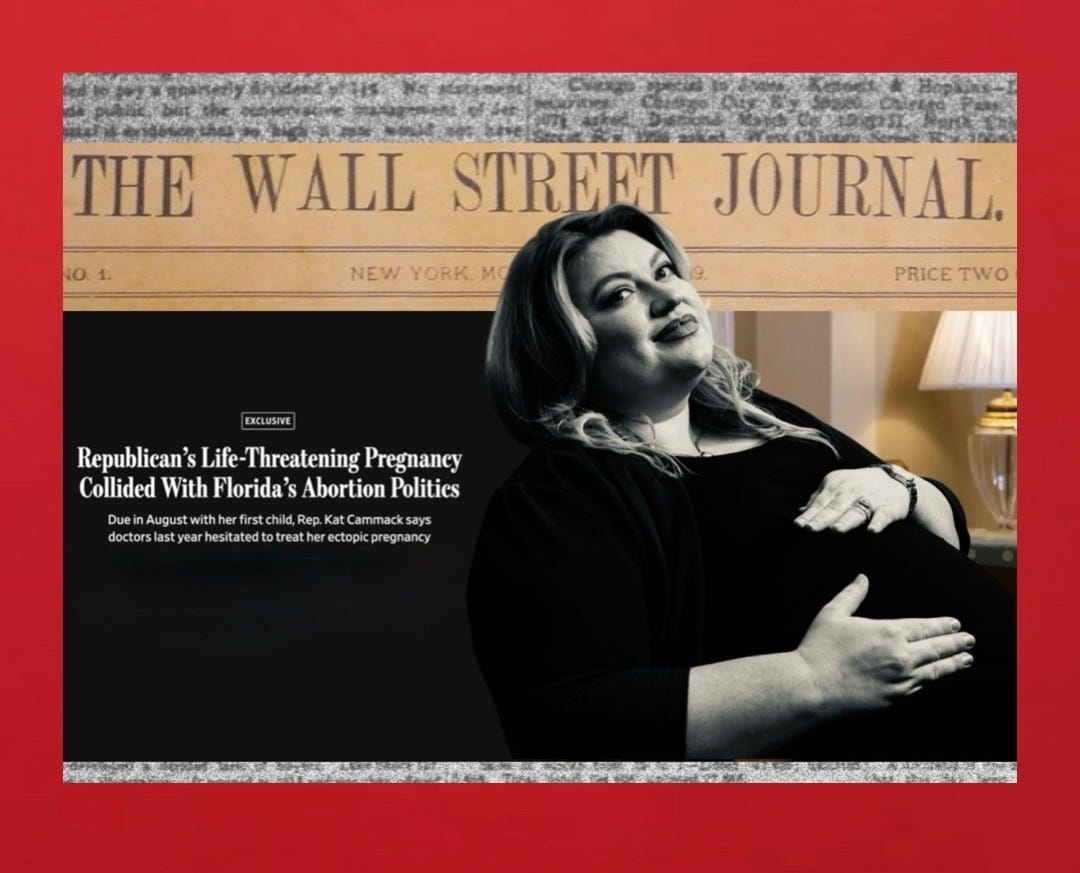
During that conversation, Cammack discussed the ectopic pregnancy she had first publicly described in an exclusive interview with The Wall Street Journal in 2025. She recounted how, while suffering a life-threatening medical emergency, treatment was delayed because hospital staff feared violating Florida’s six-week heartbeat law. She described contacting Governor Ron DeSantis’ office for legal advice while hemorrhaging.
This portion of the interview was given on the record. No conditions regarding publication were discussed before or during the interview.
The immediate aftermath
Shortly after the recording concluded, my producer, Abi Baker, was contacted by her public relations advisor Aaron Evans, who raised several concerns.
Among them were that the interview had gone longer than expected, that certain questions had not been discussed beforehand, and that the congresswoman had not anticipated being asked about the circumstances surrounding her previously public account of her pregnancy.
Later that afternoon, at 2:21 p.m., Evans connected Cammack and me directly by phone. It is this conversation that has now become the subject of public disagreement.
What I was asked
Congresswoman Cammack expressed concern about ongoing threats against her safety and explained that she feared publication would intensify those threats. I took those concerns seriously. As someone who has also received threats because of my reporting, I told her I understood why she was frightened.
My contemporaneous notes from that conversation do not reflect a proposal to delay publication until a suspect was apprehended and then proceed with publication. Instead, my notes reflect a request that the interview not be published because of ongoing safety concerns, together with a discussion about the possibility of sitting down again in the future after she had completed additional work in what she described as “the women’s healthcare space.” That distinction matters because it informed the editorial decision I ultimately had to make.
“I really don’t want to try to highlight, bring that situation back into the center for us,” Cammack said during our call following the interview. “So if there’s a way where we could not air that portion and it’s not that I’m not ever going to talk about it. I would be fine talking talking about that situation at a later time probably wrapping it up with work I’m doing in the women’s healthcare space but I just I have some real concerns.”
She added that there was an unnamed celebrity that had come forward to her office that would be involved in the future legislation and it would be a better time to discuss it after they put forward legislation.
Half way through the interview, she pivoted to say that she did not want the story released because it would be aired in an interview that also touched on Jeffrey Epstein.
“I don’t personally feel very good about it being presented in the same situation as Epstein to be candid,” she said. “Like I said while my family is going through this now it’s not something that we want to be talking about we are still dealing with the fallout from the Wall Street Journal.”
She also started to express concern about general threats from the left, not the specific case with the man who is at-large.
Why I published
I did not question that Cammack was genuinely concerned for her safety.
The question before me was different.
It was whether an on-the-record interview with a sitting member of Congress discussing a matter she had already chosen to make public—and one that bears directly on a major public policy debate—should be withheld after the interview had concluded.
I concluded that it should not.
The congresswoman had every opportunity during our interview to decline to answer any question. She did so when I asked why Trump didn’t want the Epstein files released. Instead, she answered these questions candidly and emotionally.
Her account was newsworthy not because it was private, but because she had already made it part of the public debate over abortion policy. Her additional reflections provided important context about how the law operated in practice and how she believed it affected her own medical care.
I believed then, and continue to believe now, that those comments were in the public interest.
Her experience taught me something I didn't know, and I believed it was critical for other women to hear it as well. Ultimately, I believed publishing it could save lives.
None of that diminishes my sympathy for what Congresswoman Cammack experienced. Her pregnancy emergency was harrowing, and I do not question the fear she described—for her health or for her safety. Those concerns were real. My editorial judgment was simply that they did not outweigh the public interest in publishing an on-the-record interview with a sitting member of Congress.
Access and editorial independence
During our conversation, the possibility of another interview was discussed.
At the conclusion of the call, I also understood comments made by her communications team as a warning that my decision could affect future access to Republican lawmakers.
“Every Republican member of congress will know this is how you handle this type of situation,” Evans warned me.
Journalists encounter those pressures regularly.
My responsibility was not to preserve access. It was to make an independent editorial judgment based on what was in the public interest.
Reasonable people may disagree with that judgment.
What should not be rewritten, however, is the sequence of events that led to it.
This account is based on my contemporaneous notes and the communications surrounding the interview.
What The Red Letter Stands For
I started reporting in 2009. In the years since, I have been threatened and harassed by powerful people seeking to prevent the publication of information they later wished they hadn’t disclosed, whether it emerged during on-the-record interviews or through investigative reporting.
Those moments are never easy. They require balancing empathy with a journalist’s obligation to the public. But if the standard becomes that public officials can retroactively withdraw on-the-record statements because the political consequences become uncomfortable, journalism cannot fulfill its purpose.
I launched The Red Letter because I had grown tired of watching access shape editorial decisions. Too often, important stories are softened, delayed, or abandoned altogether because someone fears losing the next interview or the next source.
I wanted to build something different—a publication that answers first to its readers rather than to the people it covers.
That doesn’t mean I don’t care about the people I interview. I do. I cared deeply about Congresswoman Cammack’s experience and about the threats she described. I took those concerns seriously. But empathy cannot become a substitute for editorial judgment.
During our conversation, the possibility of another interview was raised. I understood that to be an opportunity to revisit the subject at a later date. I also understood that choosing not to publish could preserve a valuable relationship. Every political reporter recognizes that dynamic. Access is often offered implicitly, and sometimes withheld implicitly.
But if Cammack did in fact sit down for that interview it would have been on her terms, with ample time to craft a politically correct answer on an issue that remains deeply contested in her home state. It was her raw and human response that taught me something and what made it so profound and frankly newsworthy.
The law we were discussing—the six-week abortion ban—came close to being overturned on November 5, 2024. Florida’s Amendment 4, which would have established a constitutional right to abortion before fetal viability (generally around 23 to 24 weeks) and effectively nullified the state’s six-week ban, fell just three percentage points short of the 60% threshold required to pass. The debate over the law that Congresswoman Cammack’s party supports remains politically contested in Florida.
My responsibility, however, is not to maximize access or help politicians in thorny political situations. It is to tell readers what happened as faithfully and honestly as I can. That is the promise I made when I started The Red Letter, and it remains the standard I intend to keep.
Thank you all for supporting me along the way.
She’s my representative. She’s a hypocrite. Her first vote was to overturn the election she won. 2nd vote to cut SNAP and WIC. She votes against women. Not every woman in Florida has the governor’s phone number. She just voted against the War Powers resolution and was one of the 38 who voted against the bipartisan Fair Housing bill. She’s on her “Sympathy for the Devil” tour because she is up for reelection or could be in line for Byron Donalds’ Lt. Governor. She did not appear at a Town Hall in Gainesville, her place of residence.
Note the proud display of her MAGA hat. She makes me sick.
Tara, you NEVER have to apologize to anyone for doing your “civic” responsibility in accurate reporting for public interest.
Fuck the critics.